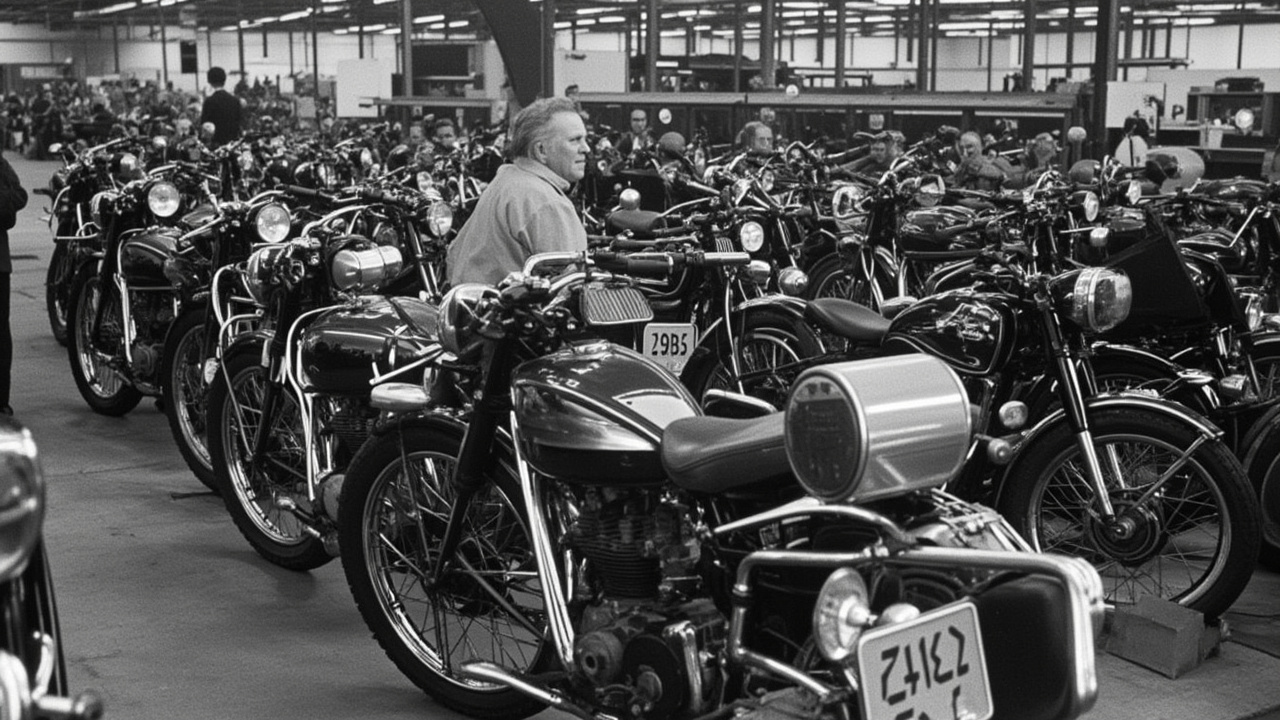
The Decline of the British Motorcycle Industry
In the early twentieth century, Britain was once the leader of the global motorcycle industry. Brands such as Triumph, BSA, Norton, and Velocette were known worldwide for their craftsmanship and technical innovation. However, after the 1970s, the British motorcycle industry declined rapidly, and by the 1990s it had almost completely withdrawn from large-scale production. This decline was the result of multiple intertwined factors.
Technical stagnation was one of the key causes. In the 1960s, as Japanese manufacturers began adopting new technologies such as DOHC (dual overhead camshaft) and CDI (capacitor-discharge ignition), most British brands continued to rely on older OHV (pushrod valve) designs and contact-point ignition systems. Although Norton's Atlas 750, introduced in 1962, used a newer DOHC engine, its cooling design was poor and reliability lagged behind Japanese competitors. Triumph's Bonneville series continued to improve during the 1960s, but its engine design had already begun to look dated.
Mistakes in market strategy also accelerated the marginalization of British brands. When Japanese brands entered the North American and European markets at scale in the 1960s with price advantages, British manufacturers failed to adjust their product strategies in time. Triumph attempted to cooperate with American importers in the late 1960s, but its insistence on high-priced product positioning caused its market share to continue falling.
Weak quality control was another fatal wound. Japanese manufacturers fully introduced statistical process control (SPC) and total quality control (TQC) in the 1960s, greatly improving product yield. British factories, meanwhile, continued using traditional manual assembly and inspection processes, and their product consistency fell far behind Japanese competitors.
In the 1970s, the British motorcycle industry experienced a wave of bankruptcies. In 1972, Norton-Villiers-Triumph (NVT) was formed in an attempt to integrate Triumph, Norton, BSA, and other brands, but it failed. After the 1973 oil crisis, a sudden drop in market demand became the final straw. BSA closed its motorcycle production division in 1970. Triumph's standard motorcycle business entered bankruptcy auction in 1983, with only the mysterious Bonneville business continuing to the present day.
Norton's fate was equally troubled. This once-glorious manufacturer was reorganized several times during the 1970s and ultimately collapsed completely in 1992. In the 1990s, Norton's brand and intellectual property were acquired by multiple parties. Today they are owned by British businessman Ted Richardson, keeping the name alive by reproducing classic models.
A small number of British brands chose to cooperate with foreign capital in order to survive. BSA was acquired by Britain's Manganese Bronze Holding and later cooperated with India's MTV. Triumph was acquired by John Bloor in 1983 and continued operating after moving to a new factory. It is now Britain's last large-scale motorcycle manufacturer, with more than five hundred employees and annual production of around thirty thousand units.
The lessons of the British motorcycle industry's decline became an important reference for industrial development in other regions. Technological innovation, market sensitivity, quality control, and cost management are the four pillars of competitiveness. The absence of any one of them can become the starting point of decline.