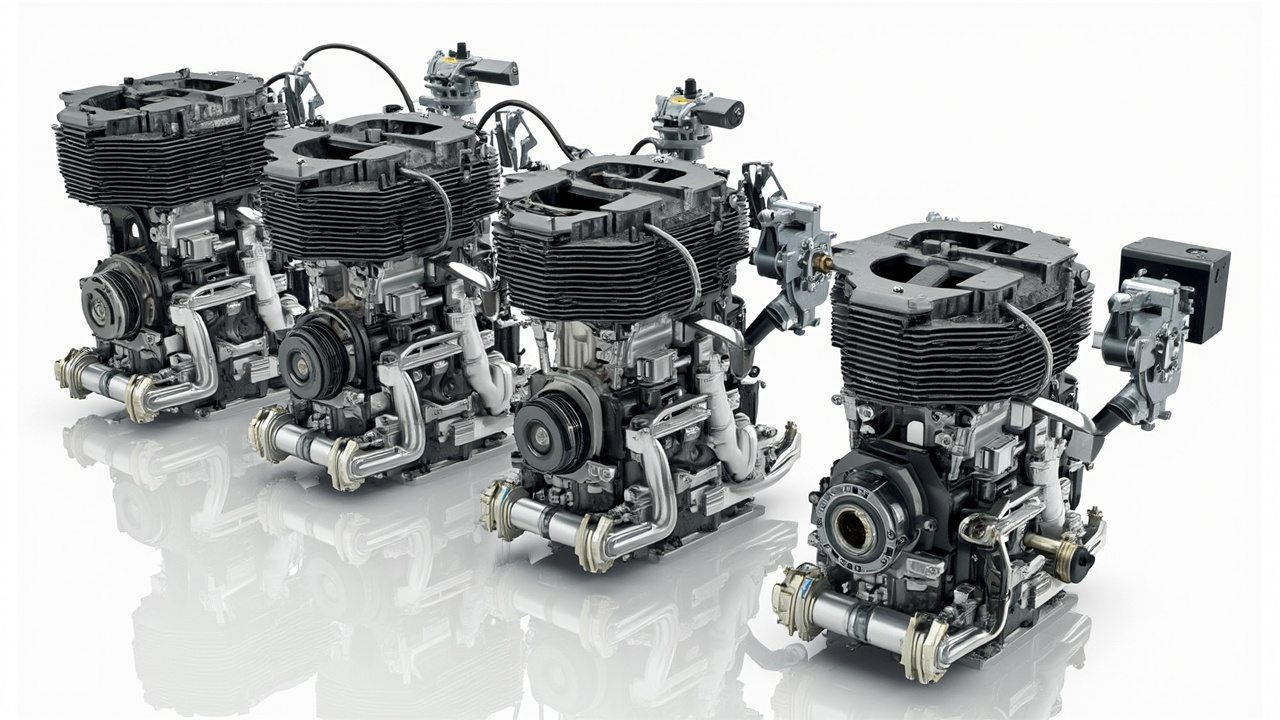
Ducati Testastretta Engine Evolution
Testastretta is one of Ducati's most representative engine families. The name comes from Italian, referring to its compact cylinder-head design (testa = head, stretta = narrow). Since its debut in the 1990s, the Testastretta engine has undergone many important evolutions. From the earliest Desmosedici Strada to the latest Testastretta DVT, this engine carries Ducati's technical essence from superbikes and MotoGP.
The origins of the Testastretta engine can be traced to 1994. That year, Ducati introduced the 916 SPS (Superbike), equipped with a 916cc liquid-cooled L-twin DOHC four-valve engine. This engine, code-named SDS (Strada), produced 103 horsepower and used advanced electronic fuel injection and distributorless ignition. The success of the 916 SPS brought Ducati unprecedented success in WSBK (World Superbike Championship).
In 1998, Ducati introduced the 999, and Testastretta displacement increased to 999cc, with maximum output rising to 120 horsepower. This engine used a more compact cylinder-head design that greatly reduced cylinder-head width and improved intake and exhaust efficiency. At the same time, Ducati introduced the Desmodromic valve-control system, fully solving the valve float problems of conventional spring valves at high rpm.
In 2003, Ducati launched the 999 RS, whose higher-performance Testastretta engine reached 140 horsepower. It used titanium connecting rods and lightweight pistons, greatly reducing internal inertial load. In 2003, the Ducati 999 RS achieved notable success in WSBK, collecting multiple race wins.
In 2005, Ducati released the 998 R and 999 R. Testastretta displacement remained at 999cc, but maximum output had increased to 160 horsepower. The engine used more efficient intake-port design and more precise engine-management systems, improving output by about thirty percentage points over earlier versions.
In 2007, Ducati reached an important technical turning point. The 1098 Superbike appeared with Testastretta displacement increased to 1099cc and maximum output rising to 180 horsepower. The engine used cooling-system optimization and a more compact cylinder layout, greatly improving heat dissipation and power characteristics. The success of the 1098 established Ducati's leadership in the superbike market and laid the foundation for later 1198 and 1299 Panigale series models.
In 2011, the 1199 Panigale debuted, with Testastretta displacement further increased to 1198cc and maximum output reaching 200 horsepower. This engine used a centrifugal mechanical supercharging system (not part of the Testastretta family), but the standard Testastretta engine had also reached the 200-horsepower class. The 1199 Panigale's electronic systems were greatly upgraded, with an IMU (inertial measurement unit) and multiple electronic control systems.
In 2015, Ducati released the 1299 Panigale Final Edition, with Testastretta displacement reaching 1299cc and maximum output of around 220 horsepower. However, this also represented the performance bottleneck of the traditional Testastretta twin-cylinder engine. To solve this problem, Ducati began developing the new Testastretta DVT (Desmodromic Variable Timing) engine.
In 2016, Ducati introduced the 1299 Panigale S SE, equipped with the Testastretta DVT engine. This engine used Variable Valve Timing, automatically adjusting valve timing according to engine speed and load to balance low-rpm torque with high-rpm horsepower. The introduction of this technology made the Testastretta's power curve more linear and greatly improved practicality.
The evolution of the Testastretta engine family reflects Ducati's sustained investment in technical development. From the 916 of the 1990s to the Testastretta DVT of the 2020s, this engine has undergone roughly thirty years of continuous refinement and has become one of the classic cases in motorcycle engineering history.