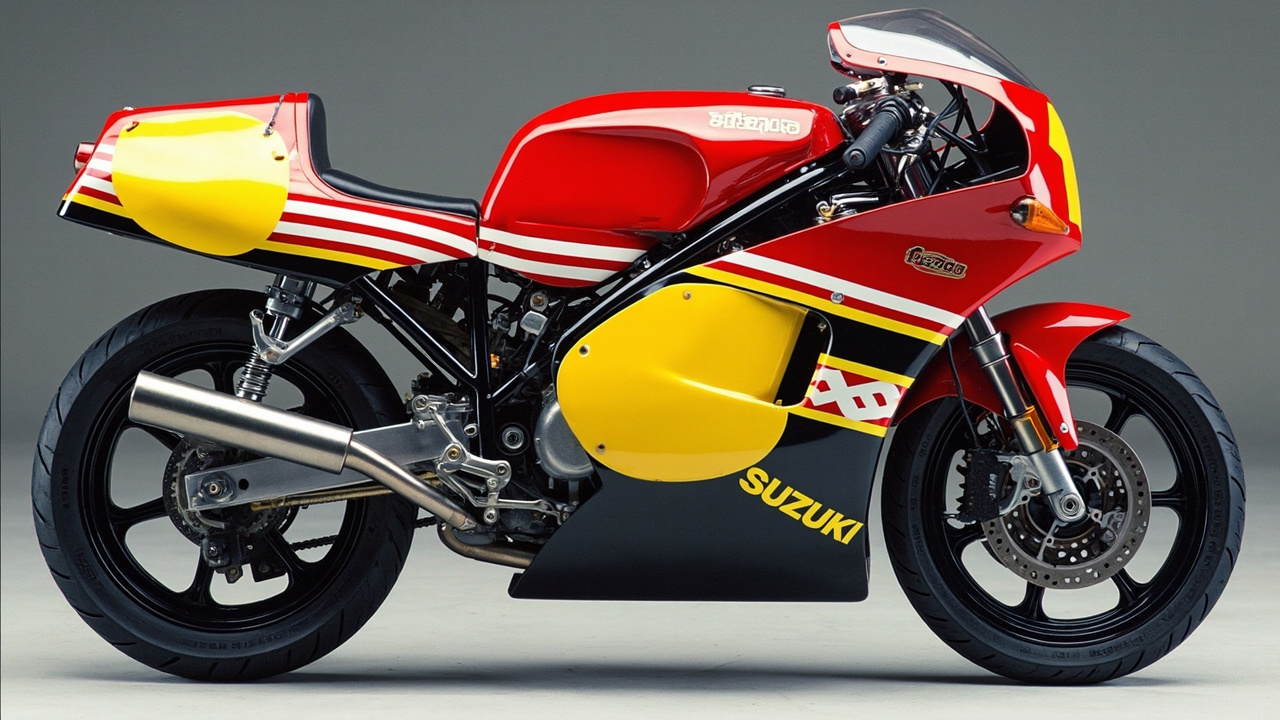
Suzuki's Two-Stroke Motorcycle Legacy
Suzuki's technical accumulation and product achievements in two-stroke motorcycles made it an important symbol of the two-stroke era from the 1970s to the 1990s. From the Dream D of the 1960s to the RGV500 of the 1990s, Suzuki's two-stroke legacy covered a complete product line from small and mid-displacement off-road motorcycles to large-displacement race bikes.
Suzuki's two-stroke history can be traced to 1952. That year, the company introduced the Power Free, a motorcycle equipped with a 60cc two-stroke engine that produced more power than comparable models. The success of the Power Free established Suzuki's basic technology for two-stroke engine development and led to the 1962 launch of the T20 Team 20.
The T20 was an important milestone in Suzuki's two-stroke technology. Equipped with a 247cc two-stroke twin-cylinder engine, it produced thirty horsepower, about twenty percentage points more than competitors in the same class. The T20 focused on improving intake efficiency and mixture atomization, using advanced CDI (capacitor-discharge ignition) and rotary-valve intake technology. These technologies established Suzuki's leading position in small and mid-displacement two-strokes.
In the 1970s, Suzuki's two-stroke technology moved into larger displacements. In 1972, the Suzuki TM400 Cyclone appeared, equipped with a 400cc two-stroke single-cylinder engine and becoming one of the most powerful single-cylinder motorcycles of the time. The TM400 was designed to meet both road and off-road needs, using a switchable exhaust system to balance low-end torque and high-rpm horsepower.
In 1976, Suzuki introduced the PE250, an off-road motorcycle using a 250cc two-stroke single-cylinder engine, emphasizing light weight and handling. The success of the PE250 established Suzuki's foundation in off-road motorcycles and gave rise to the later RM series.
In the 1980s, Suzuki's two-stroke technology reached its peak. In 1982, the Suzuki RC80 appeared, an 80cc two-stroke engine designed specifically for Grand Prix motocross and using what was described as the most advanced Yamaha RD-series engine technology of the time. In 1988, the Suzuki RGV500 (Gamma) appeared. This 500cc two-stroke V-four GP factory race bike represented Suzuki's highest two-stroke achievement. The RGV500 used a 78-degree V-four design, produced more than 130 horsepower, and weighed only about 130 kilograms, giving it an outstanding power-to-weight ratio.
The RGV250 also inherited the essence of two-stroke technology. In 1988, Suzuki introduced the RGV250, using a 250cc V-twin engine trimmed to 85hp at 9500rpm. This model occupied an important position in 250cc-class competition from the late 1980s to the early 1990s.
In the 1990s, Suzuki continued innovating in two-stroke technology. In 1994, the Suzuki RGV500 SP (Special Production) appeared, using a more compact engine design and a more efficient cooling system, with maximum output increased to 140 horsepower. However, by this time environmental regulations were increasingly restricting two-stroke engines, and manufacturers began shifting resources to four-stroke engine development.
In 1998, Suzuki announced the end of its two-stroke engine development program. Although it later regretted this decision, the technical experience and brand assets Suzuki had accumulated during the two-stroke era continued to influence its later product development. The TL1000S and TL1000R introduced in the 2000s used V-twin engines, and their power-delivery characteristics showed a clear inheritance from the two-stroke era.
The influence of Suzuki's two-stroke legacy remains visible today. Suzuki's two-stroke engines, especially its liquid-cooled V-twin and V-four designs, influenced the development direction of many later motorcycles. In addition, the reliable brand image Suzuki built during the two-stroke era helped it establish a solid position in the motorcycle market.