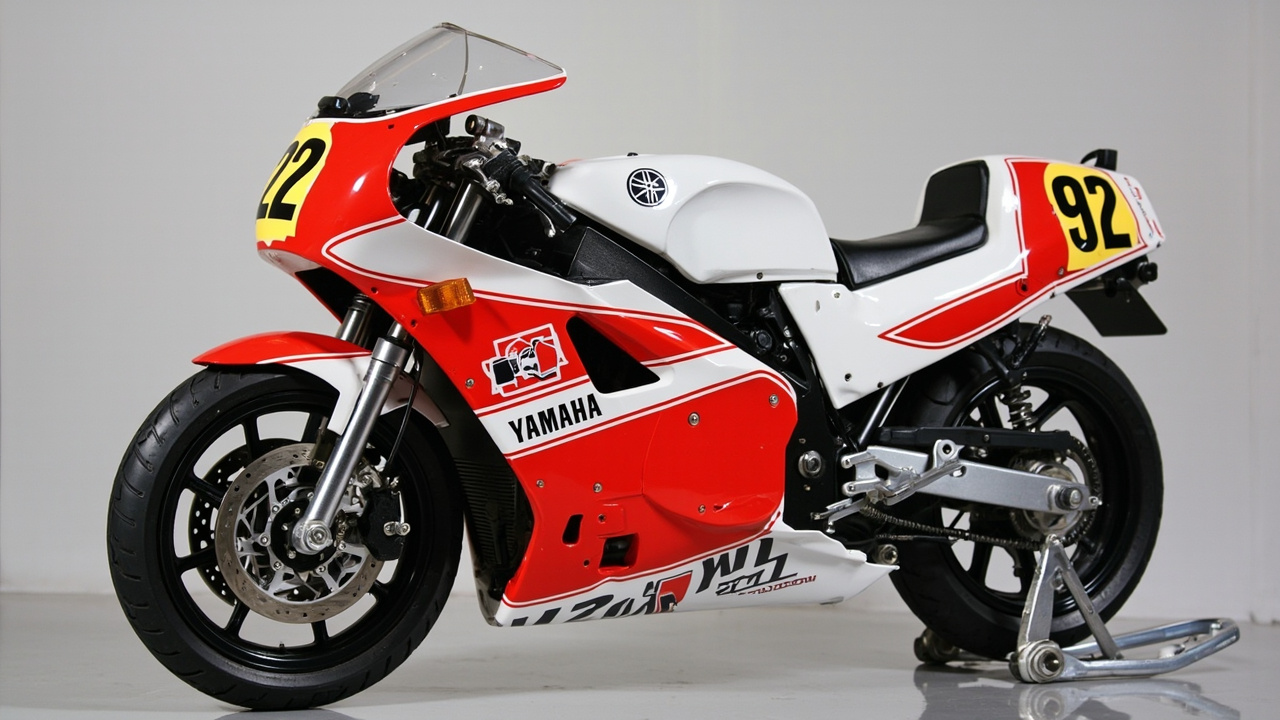
The Yamaha YZR500 Technical Legend
The Yamaha YZR500 (also known as OW01) was one of the most legendary four-stroke race bikes from the late 1980s to the early 1990s. Its crossplane-crankshaft V-four engine, with unique power characteristics and an extreme lightweight design, became a representative work of Yamaha MotoGP technology.
The development background of the YZR500 can be traced to 1986. At the time, Yamaha competed in the 500cc World Championship with the YZR250, but found that the performance of the 250cc two-stroke V-twin engine was approaching its limits. Meanwhile, although 1988 MotoGP rules still allowed two-stroke engines, Yamaha's engineering team believed four-stroke engines might have advantages in larger-displacement classes. Thus, the YZR500 development program officially began.
The YZR500 used a 999cc liquid-cooled four-stroke V-four DOHC five-valve engine (five valves per cylinder). This engine, code-named YZR500E, used a crossplane crankshaft design. This design gave the four cylinders uneven firing intervals, creating unique power delivery. The crossplane crankshaft reduced the cancellation of internal inertial forces, allowing the engine to run at higher rpm while reducing vibration.
The YZR500's engine design, code-named the YZR500E generation, produced about 150 horsepower and could reach 13000rpm. To achieve extreme lightness, Yamaha used large amounts of aluminum alloy and titanium alloy parts. Titanium connecting rods, magnesium-alloy engine covers, and carbon-fiber body panels kept the YZR500's weight to around 130 kilograms.
For the frame, the YZR500 used an aluminum-alloy twin-spar frame. Compared with a traditional tubular steel frame, this design was stronger and lighter, providing better handling stability and a balance of rigidity. The YZR500 frame design influenced the development direction of later Yamaha MotoGP factory bikes.
In 1988, the Yamaha YZR500 officially entered competition. The first customers were private teams and amateur track enthusiasts. Yamaha supplied these customers with assembled complete machines rather than full factory race-bike technical support. The production version of the YZR500 (code-named YZR500 0W01) differed from the factory race bike, mainly because of road-use regulations and cost control.
On the racetrack, riders such as Wayne Rainey and Kenny Roberts competed on the Yamaha YZR500. In 1990, Rainey rode the Yzr500 to win the 500cc world championship, Yamaha's first world title in the four-stroke 500cc class. In 1992, Luigi also competed on the YZR500 and achieved respectable results before decline.
However, the YZR500's racing career was not smooth. From 1989 to 1990, reliability problems troubled the teams. The crossplane-crankshaft engine placed heavy stress on bearings and the lubrication system during prolonged high-rpm operation, causing multiple engine failures. These problems were not better resolved until the mid-1990s.
The YZR500's technical legacy continued into the mid-1990s YZR500 (0W8). In 1994, Yamaha introduced a newly designed YZR500, using a more compact engine layout and more efficient cooling system. Although it shared the YZR500 name, this model's engine design differed significantly from the 0W01, abandoning the crossplane crankshaft in favor of a conventional flat-plane crankshaft to improve reliability.
The historical significance of the YZR500 lies in its demonstration of the potential of four-stroke engines in top-level motorcycle racing. Although two-stroke engines still held advantages during its active years, the YZR500's technical accumulation laid an important foundation for Yamaha's later MotoGP factory-bike development. In the 2000s, Yamaha's YZR-M1 (M1) inherited the technical essence of the YZR500 and continued writing legend in the four-stroke era.