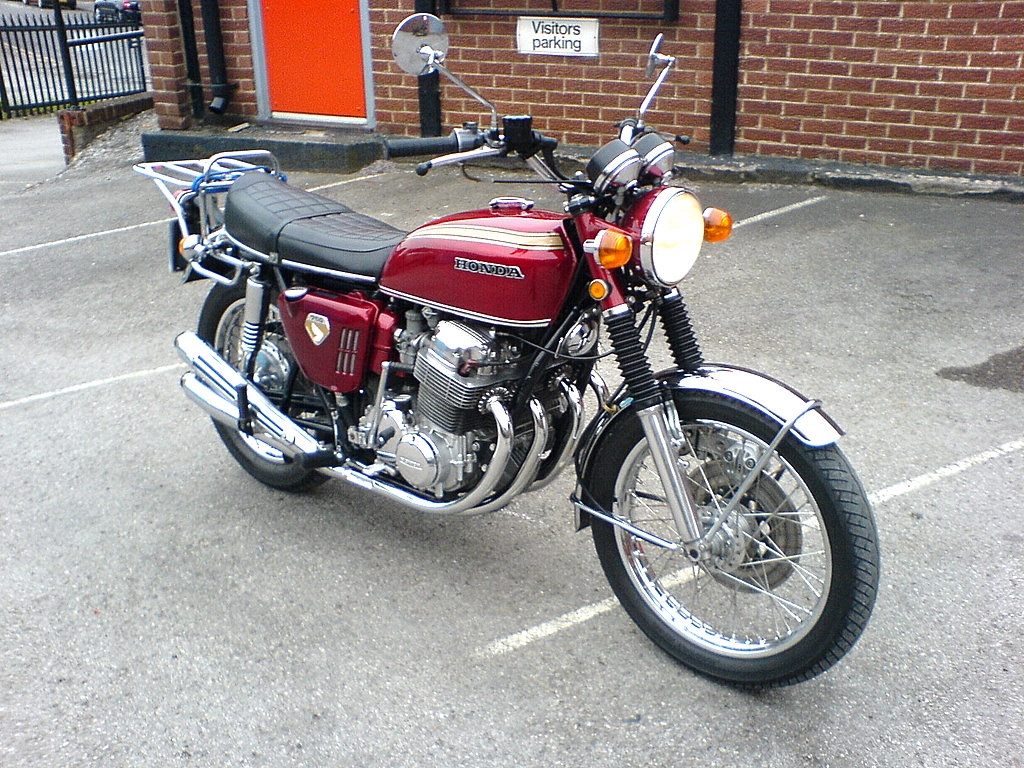
Honda CB750 (1969) — The Motorcycle That Changed Everything
The Honda CB750, introduced in 1969, is widely regarded as the world's first superbike. It combined unprecedented power, reliability, and value in a package that revolutionized the motorcycling industry.
Historical Significance
The CB750 wasn't just another motorcycle—it was a statement of intent from Honda. For years, British and American manufacturers dominated the large-displacement market with underpowered, unreliable machines. Honda changed that by applying the same meticulous engineering that made their small bikes famous to a machine that could compete with the best Europe had to offer.
The CB750 featured Honda's first production inline-four engine—a 749cc DOHC (later SOHC) design that produced 67 horsepower. This was nearly double the output of contemporary rivals and gave the CB750 a top speed exceeding 125 mph (201 km/h).
Technical Highlights
Engine & Powertrain
The air-cooled 749cc inline-four featured two valves per cylinder (later upgraded to four valves for improved flow). The SOHC design used a single overhead camshaft operating the valve train via rockers, while later DOHC variants used a more complex but higher-revving setup.
The five-speed transmission delivered power smoothly, and the CB750's reliability was groundbreaking—owners reported minimal maintenance beyond routine valve adjustments and tire changes.
Handling & Brakes
The CB750 introduced front disc brakes to the Japanese motorcycle industry. Dual 10.8-inch discs with floating calipers provided stopping power previously unseen on production motorcycles. The tubular steel frame and 41mm front fork delivered composed handling that satisfied both commuting riders and touring enthusiasts.
Cultural Impact
The CB750 became the foundation of Honda's reputation for building technical marvels at accessible prices. It democratized high-performance motorcycling, showing that a Japanese manufacturer could deliver European-style performance with Japanese reliability at a fraction of the cost.
Racing derivatives like the CB750 Kreiger and CR750 proved the platform's potential, dominating endurance races throughout the 1970s.
The CB750 remained in production until 2008, evolving through multiple generations including the DOHC variants, the CB750A Hondamatic (Honda's first automatic transmission motorcycle), and later fuel-injected models.
Visual Character
The original 1969 CB750 featured a teardrop fuel tank with gently sloping sides, a long bench seat, and wire-spoke wheels. Common color schemes included:
- Candy Orange with white side panels
- Candy Blue with silver side panels
- Black with chrome accents
The distinctive four-into-one megaphone exhaust became an iconic silhouette, and the circular headlight with chrome bezel defined Honda's design language for decades.
Source: Wikipedia - Honda CB750 and CR750